My Favorite Dance Songs of the Decade Before (2010-2019)

by Bryan Arthur Williams

Expanded and updated for the Coronavirus Era!

Remember a time when we were able to touch our friends, go on dates with lovers or strangers, dance together, and sing together in large groups? That was a little over a month ago. To jog your memory, I offer you this playlist of many of my favorite dance songs released in the last decade before the pandemic, 2010-2019.

Songs in bold italics are my 35 absolute favorites. Titles are linked to YouTube videos (audio or lyrics videos, wherever possible), while the year is followed by a link to annotated lyrics on Genius.

If you enjoy these songs, steal them! Make them yours! Steal a wave or two, or steal the whole playlist! Listen to it in your living room or kitchen. Or if you ever leave your house, listen in your car! Use it for 3-minute to 13-hours dance parties, by yourself or with whoever is part of your lockdown family! And with friends via the online platform of your choice!

And if you don’t feel like dancing, or are still, while facing death, determined to believe that you cannot, some of these could be great accompaniment for other activities. As Carly Rae Jepsen put it, halfway through the last decade, “I didn’t just come here to dance, if you know what I mean, do you know what I mean?”

I spend, or at least used to spend, a lot of time dancing and thinking about the qualities of good dance music. From 2004 until 2014, I mostly practiced ecstatic dance, in Austin TX, where I live, often once or twice a week. For three years, I also worked as an ecstatic dance facilitator (like a DJ with additional responsibilities). In January 2015, I discovered I also enjoy club dancing, having somehow only done it a few times previously. Since then, and until it closed in early March, I danced at Austin club Barbarella at least once a week, and studied how the DJs work.

The playlist is made up of 203 songs (12 hrs 51 mins), divided into 18 “waves” for dancing, as they are called in the ecstatic dance. Songs on front side of the tempo/intensity peak have a building/rising quality, and those on the back side, a diminishing/falling quality, until the start of the next wave. The last wave is less intense, and made up – apart from Sylvan Esso’s “Come Down” – of songs I have danced to, at least once, during the final hour (2-3am) on Saturday nights at Barbarella.

This link plays samples of the first hundred songs and will take Spotify Premium users to a complete playlist matching my song order below (sadly, the free version of Spotify shuffles all playlists):

THE PLAYLIST!

WAVE 1 (44:06)

Got It – Marian Hill (2014, lyrics)

Hands to Myself – Selena Gomez (2015, lyrics)

Girls Like – Tinie Tempah, feat. Zara Larsson (2016, lyrics)

Banana Brain – Die Antwoord (2016, lyrics)

Titanium – David Guetta, feat. Sia (2011, lyrics)

Clearest Blue – CHVRCHES (2015, lyrics)

Call Your Girlfriend – Robyn (2010, lyrics)

Good Day – Yellow Claw, feat. DJ Snake & Elliphant (2017, lyrics)

Say My Name – David Guetta, Bebe Rexha & J Balvin (2018, lyrics)

Cool Girl – Tove Lo (2016, lyrics)

You Know You Like It – DJ Snake & AlunaGeorge (2014, lyrics)

bad guy – Billie Eilish (2019, lyrics)

WAVE 2 (37:58)

Formation – Beyoncé (2016, lyrics)

Bodak Yellow – Cardi B (2017, lyrics)

Mi Gente (Remix) – J Balvin & Willy William, feat. Beyoncé (2017, lyrics)

Uyibambe – Distruction Boyz, feat. DJ Tira & Rude Boyz ZA (2017, no lyrics)

I Love It – Icona Pop, feat. Charli XCX (2012, lyrics)

Do It Again – Röyksopp & Robyn (2014, lyrics)

Danza Kuduro – Don Omar, feat. Lucenzo (2010, lyrics)

Despacito (Remix) – Luis Fonsi & Daddy Yankee, feat. Justin Bieber (2017, lyrics)

Se Preparó – Ozuna (2017, lyrics)

Down – Marian Hill (2016, lyrics)

WAVE 3 (31:58)

Truth Hurts – Lizzo (2017, lyrics)

Hello Bitches – CL (2015, lyrics)

Work Bitch – Britney Spears (2013, lyrics)

Emergency – Icona Pop (2015, lyrics)

Bitch Better Have My Money – Rihanna (2015, lyrics)

Kamikaze – MØ (2015, lyrics)

Ciao Adios – Anne-Marie (2017, lyrics)

Same Old Love – Selena Gomez (2015, lyrics)

Coffee – Sylvan Esso (2014, lyrics)

WAVE 4 (52:09)

Familiar – Agnes Obel (2016, lyrics)

Pulse – Cash+David (2014, lyrics)

Oblivion – Grimes (2012, lyrics)

Wut – Le1f (2012, lyrics)

Wet Dollars – Tink, feat. Tazer (2015, lyrics)

I Fink U Freeky – Die Antwoord (2012, lyrics)

212 – Azealia Banks, feat. Lazy Jay (2011, lyrics)

Can’t Hold Us – Macklemore & Ryan Lewis, feat. Ray Dalton (2011, lyrics)

Starships – Nicki Minaj (2012, lyrics)

What About Us – P!nk (2017, lyrics)

Starboy – The Weeknd, feat. Daft Punk (2016, lyrics)

rockstar – Post Malone, feat. 21 Savage (2017, lyrics)

Lil Bebe – DaniLeigh (2018, lyrics)

Give Up – FKA Twigs (2014, lyrics)

WAVE 5 (41:09)

Why This Kolaveri Di? – Anirudh Ravichander & Dhanush (2011, lyrics)

Sail – AWOLNATION (2010, lyrics)

Believer – Imagine Dragons (2017, lyrics)

Rubber Band Stacks – Brooke Candy (2015, lyrics)

Too Original – Major Lazer, feat. Elliphant & Jovi Rockwell (2015, lyrics)

We Found Love – Rihanna, feat. Calvin Harris (2011, lyrics)

Levels (Radio Edit) – Avicii (2011, lyrics)

Dancing On My Own – Robyn (2010, lyrics)

Hideaway – Kiesza (2014, lyrics)

Don’t Let Me Down – The Chainsmokers, feat. Daya (2016, lyrics)

Faded – Alan Walker [feat. ISELIN] (2015, lyrics)

WAVE 6 (44:07)

Tilted – Christine and the Queens (2015, lyrics)

Le Goudron – YACHT (2012, lyrics)

Ni**as in Paris – Jay-Z & Kanye West (2011, lyrics)

Bad Girls – M.I.A. (2013, lyrics)

Heavy Metal and Reflective – Azealia Banks (2014, lyrics)

Kill V. Maim – Grimes (2015, lyrics)

Born This Way – Lady Gaga (2011, lyrics)

Love Is Free (Original Mix) – Robyn & La Bagatelle Magique, feat. Maluca (2015, lyrics)

WTF (Where They From) – Missy Elliott, feat. Pharrell Williams (2015, lyrics)

Lean On – Major Lazer & DJ Snake, feat. MØ (2015, lyrics)

It Ain’t Me – Kygo & Selena Gomez (2017, lyrics)

Mantissa – Marina Satti (2017, lyrics)

WAVE 7 (42:30)

Dance Yrself Clean – LCD Soundsystem (2010, lyrics)

King Kunta – Kendrick Lamar (2015, lyrics)

Uptown Funk – Mark Ronson, feat. Bruno Mars (2014, lyrics)

When I Was Young – MØ (2017, lyrics)

Light It Up (Remix) – Major Lazer, feat. Nyla & Fuse ODG (2015, lyrics)

The Greatest – Sia (2016, lyrics)

REALiTi (Demo) – Grimes (2015, lyrics)

Havana – Camila Cabello, feat. Young Thug (2017, lyrics)

Love Lies – Khalid & Normani (2018, lyrics)

Drew Barrymore – SZA (2017, lyrics)

WAVE 8 (52:50)

Royals – Lorde (2013, lyrics)

Gold – Kiiara (2015, lyrics)

H.S.K.T. – Sylvan Esso (2014, lyrics)

Mi Rumba – Sofi Tukker & ZHU (2019, lyrics)

Good Mistake – Mr. Little Jeans (2014, lyrics)

Happy Idiot – TV on the Radio (2014, lyrics)

Gangnam Style – PSY (2012, lyrics)

Elephant – Tame Impala (2012, lyrics)

Heavy Metal Lover – Lady Gaga (2011, lyrics)

Huarache Lights – Hot Chip (2015, lyrics)

Cream On Chrome – Ratatat (2015, no lyrics)

Black Heart – Carly Rae Jepsen (2015, lyrics)

Occupied – The Radio Dept. (2015, lyrics)

WAVE 9 (43:27)

Cheap Thrills – Sia (2016, lyrics)

Radio – Sylvan Esso (2016, lyrics)

New Rules – Dua Lipa (2017, lyrics)

Cut to the Feeling – Carly Rae Jepsen (2017, lyrics)

Bang Bang – Jessie J, Ariana Grande & Nicki Minaj (2014, lyrics)

Wake Me Up – Avicii (2013, lyrics)

Summertime Sadness (Remix) – Lana Del Rey vs. Cedric Gervais (2013, lyrics)

Cool for the Summer – Demi Lovato (2015, lyrics)

Boys – Charli XCX (2017, lyrics)

I Like It – Cardi B, Bad Bunny & J Balvin (2018, lyrics)

Panda – Desiigner (2015, lyrics)

Sorry – Beyoncé (2016, lyrics)

WAVE 10 (56:19)

Scuse Me – Lizzo (2016, lyrics)

Old Town Toad (Remix) – Lil Nas X, feat. Billy Ray Cyrus (2019, lyrics)

Work – Rihanna, feat. Drake (2016, lyrics)

Stereo Love – Edward Maya & Vika Jigulina (2010, lyrics)

Supernatural – AlunaGeorge (2014, lyrics)

Shape of You – Ed Sheeran (2017, lyrics)

You Don’t Know Me – Jax Jones, feat. RAYE (2016, lyrics)

Swish Swish – Katy Perry, feat. Nicki Minaj (2017, lyrics)

Ice Princess – Azealia Banks (2014, lyrics)

7/11 – Beyoncé (2014, lyrics)

Y.A.L.A. – M.I.A. (2013, lyrics)

The Man – The Killers (2017, lyrics)

Feel It Still – Portugal. The Man (2017, lyrics)

Brightside – Icona Pop (2016, lyrics)

Yoga – Janelle Monáe & Jidenna (2015, lyrics)

One Dance – Drake, feat. Wizkid and Kyla (2016, lyrics)

WAVE 11 (37:47)

Team – Lorde (2013, lyrics)

Tempo – Lizzo, feat. Missy Elliot (2019, lyrics)

Blow – Kesha (2010, lyrics)

Someone Who Can Dance – Icona Pop (2016, lyrics)

Baby’s on Fire – Die Antwoord (2012, lyrics)

Club Now Skunk – Elliphant, feat. Big Freedia (2015, lyrics)

Midnight City – M83 (2011, lyrics)

King – Years & Years (2015, lyrics)

Prayer in C (Robin Schulz Radio Edit) – Lilly Wood & The Prick and Robin Schulz (2014, lyrics)

Fool for Love – Lord Huron (2015, lyrics)

Wolf – Sylvan Esso (2014, lyrics)

WAVE 12 (34:12)

Beez in the Trap – Nicki Minaj, feat. 2 Chainz (2012, lyrics)

Lemon – N.E.R.D., Rihanna, and Pharrell Williams (2017, lyrics)

Straight Outta Vagina – Pussy Riot, feat. Desi Mo and Leikeli47 (2016, lyrics)

Yung Rapunxel – Azealia Banks (2013, lyrics)

Venus Fly – Grimes, feat. Janelle Monáe (2015, lyrics)

XXX 88 – MØ, feat. Diplo (2013, lyrics)

Class Historian – BRONCHO (2014, lyrics)

Love Like Ghosts – Lord Huron (2015, lyrics)

Die Young – Sylvan Esso (2017, lyrics)

WAVE 13 (40:04)

Let It Happen – Tame Impala (2015, lyrics)

Tongues – Joywave, feat. KOPPS (2015, lyrics)

Tik Tok – Kesha (2010, lyrics)

Problem – Ariana Grande, feat. Iggy Azalea (2014, lyrics)

HUMBLE. – Kendrick Lamar (2017, lyrics)

This Is America – Childish Gambino (2018, lyrics)

Cold Water – Major Lazer, feat. MØ and Justin Bieber (2016, lyrics)

Waterfall (SeeB Remix) – Stargate, feat. P!nk and Sia (2017, lyrics)

Los Ageless – St. Vincent (2017, lyrics)

Go – Grimes, feat. BloodPop® [formerly Blood Diamonds] (2014, lyrics)

WAVE 14 (38:00)

bury a friend – Billie Eilish (2019, lyrics)

Ch-Ching – Chairlift (2016, lyrics)

Money – Cardi B (2018, lyrics)

Karaoke – Big Freedia, feat. Lizzo (2018, lyrics)

Famous – Charli XCX (2014, lyrics)

This Is What You Came For – Calvin Harris, feat. Rihanna (2016, lyrics)

I Know a Place – MUNA (2017, lyrics)

Take Shelter – Years & Years (2015, lyrics)

God Is a Woman – Ariana Grande (2018, lyrics)

Drunk In Love – Beyoncé, feat. Jay-Z (2014, lyrics)

WAVE 15 (36:22)

Celoso – Lele Pons (2018, lyrics)

Side to Side – Ariana Grande, feat. Nicki Minaj (2016, lyrics)

Sucker – Jonas Brothers (2019, lyrics)

Pray to God – Calvin Harris, feat. HAIM (2014, lyrics)

THE BADDEST FEMALE 나쁜 기집애 – CL (2013, lyrics)

Taki Taki – DJ Snake, feat. Selena Gomez, Ozuna, and Cardi B (2018, lyrics)

Vroom Vroom – Charli XCX (2016, lyrics)

Ocean Drive – Duke Dumont (2015, lyrics)

California – Grimes (2015, lyrics)

Doses & Misosas – Cherub (2014, lyrics)

WAVE 16 (42:15)

Partition – Beyoncé (2014, lyrics)

the light is coming – Ariana Grande, feat. Nicki Minaj (2018, lyrics)

you should see me in a crown – Billie Eilish (2019, lyrics)

Juice – Lizzo (2019, lyrics)

Firework – Katy Perry (2012, lyrics)

Electric Love – BØRNS (2015, lyrics)

Into You – Ariana Grande (2016, lyrics)

The World Ender – Lord Huron (2015, lyrics)

Hold Up – Beyoncé (2016, lyrics)

Fetish – Selena Gomez, feat. Gucci Mane (2017, lyrics)

Two Weeks – FKA Twigs (2014, lyrics)

WAVE 17 (45:34)

Water Water – Empress Of (2015, lyrics)

I Thought the Future Would Be Cooler – YACHT (2015, lyrics)

IDGAF – Dua Lipa (2017, lyrics)

I Took a Pill in Ibiza (SeeB Remix) – Mike Posner (2016, lyrics)

Slip Away – Perfume Genius (2017, lyrics)

Dance Monkey – Tones and I (2019, lyrics)

She Lit a Fire – Lord Huron (2012, lyrics)

Hotline Bling – Drake (2015, lyrics)

The Night We Met [feat. Phoebe Bridgers] – Lord Huron, feat. Phoebe Bridgers (2018/2015, lyrics)

Claire de Lune – Flight Facilities, feat. Christine Hoberg (2014, lyrics)

Dust Is Gone (Night Version) – MØ (2014, lyrics)

WAVE 18 (50:33)

Genesis – Grimes (2012, lyrics)

Paradise Awaits – ZHU (2014, lyrics)

Flesh Without Blood – Grimes (2015, lyrics)

Green Light – Lorde (2017, lyrics)

Roses – The Chainsmokers, feat. ROZES (2015, lyrics)

Nights With You – MØ (2017, lyrics)

I Follow Rivers  (Remix) – Lykke Li, feat. The Magician (2011, lyrics)

bodyache – Purity Ring (2015, lyrics)

Florida Kilos – Lana Del Rey (2014, lyrics)

Never Be Like You – Flume, feat. Kai (2016, lyrics)

Gooey – Glass Animals (2014, lyrics)

Come Down – Sylvan Esso (2014, lyrics)

Final Song – MØ (2016, lyrics)

***
The Knockout Stage of the Women’s World Cup, 1991-2019

by Bryan Arthur Williams

Now that France 2019 is over, here are some facts about the Knockout Stage* of the eight Women’s World Cup tournaments (1991-2019):

There have only been 80 knockout games ever played, through the 2019 Final. The Round of 16 was only introduced to the tournament in 2015. Between 1991 and 2011, the Group Stage led straight to quarterfinals.

The United States has now won the World Cup four times — in 1991, 1999, 2015, and 2019. Germany has won twice — in 2003 and 2007. They have never met in the Final.

The only other teams to win the World Cup are Japan, who beat the United States in 2011, and Norway, who beat Germany in 1995. Japan and Norway have also each lost the Final once — Japan to the US in 2015, and Norway to the US in 1991. Other teams who have played in the Final are China (1999), Sweden (2003), Brazil (2007), and now Netherlands, who in 2019 became the seventh finalist of history. China and Netherlands lost to the US, Sweden and Brazil to Germany.

With the addition of Netherlands in 2019, only eleven nations have ever played in the semifinals. The United States has done it eight times, reaching the semifinals of every World Cup and never finishing lower than third place. Germany has reached the semifinals five times; Norway and Sweden four times each; Brazil, China, Japan, and England twice each; and one appearance each for Canada, France, and Netherlands.

Two-time semifinalist Brazil have reached the Final once, losing to Germany in 2007. They were the third place winner in 1999, the first time they advanced from the Group Stage. They have advanced in the five World Cups since.

Of the 2019 semifinalists — England, the United States, Sweden, and Netherlands —only two have ever met each other in any World Cup knockout game:

The 2019 semifinal between England and the United States was a rematch of a 2007 quarterfinal, which the US won 3-0. Jill Scott, Karen Carney, and Carly Telford remained for England from the 2007 squad, while for the US, only Carli Lloyd. Three of the four – Scott, Telford, and Lloyd – played in the 2019 semifinal.

Of the 2019 semifinalists, only US and Sweden have ever met in the Group Stage, where they have been drawn to the same group six times. The US prevailed in four of those meetings (1991, 2003, 2007, and 2019), Sweden in one (2011), and there was one tie (2015).

Only 23 nations have ever advanced to the Knockout Stage. Here are their records in knockout games, by FIFA region:

No team from the Oceania region (OFC) has ever advanced from the Group Stage.

Teams from the African region (CAF) have yet to win a single knockout game. The only teams to advance from the Group Stage, Cameroon and Nigeria, are each 0-2.

Teams from the Asian region (AFC) have a 10-19 record overall in knockout games. Japan is the only team with a winning record: 6-4. China is 3-8, Australia is 1-4. Taiwan, South Korea, and North Korea are all 0-1.

The South American region (CONMEBOL) has only ever been represented in the Knockout Stage by two teams, Colombia and Brazil. Colombia is 0-1, its only appearance being in 2015. Brazil is 4-6.

The North/Central American & Caribbean region (CONCACAF) has also only ever been represented by two teams in the Knockout Stage — Canada and the United States. The region has an overall 24-8 record in knockout games. Canada is 2-4, the United States is 22-4.

The European region (UEFA) has a 42-41 record in knockout games. With the addition of Spain in 2019, 11 different European teams have now advanced from the Group Stage: Germany is 13-7; Sweden 10-6; Netherlands 3-2; England 5-6; Norway 7-9; France 3-4; Italy 1-2; Denmark 0-2; Russia 0-2; Switzerland 0-1; and Spain 0-1.

***

*The Knockout Stage follows the round-robin Group Stage. These facts are inclusive of 3rd place games, which FIFA considers part of the Knockout Stage, though both teams have already been knocked out.

Examining an Offside Decision in Italy-China (World Cup 2019)

by Bryan Arthur Williams

As coverage of World Cup 2019 has demonstrated, Law 11 (Offside) remains the most misunderstood law of the game. Hopefully this analysis of the offside decisions involved in a single attacking play in the Italy-China Round of 16 match will be clarifying.

FOX commentators misunderstood the decisions, suggesting that China #10 Li was “offside on the initial kick,” while the offside player was, in fact, China #11 Wang, and not because of her position at the moment of the kick.

Though what they were watching on the replay was clearly inconsistent with their explanation, commentators neglected to seek assistance from their Rules Analyst Christina Unkel, who also a current FIFA referee.

Analysis


During any attacking play, the AR (assistant referee) is taking a series of mental “snapshots.” A new snapshot is required for each final touch by an attacking player (sometimes there is only a single touch – as with all three snapshots below) or with a deliberate play of the ball by a defending player.

Each snapshot resets the offside decision, allowing any attacker who is onside, at the moment of the new snapshot, to play the ball without penalty.


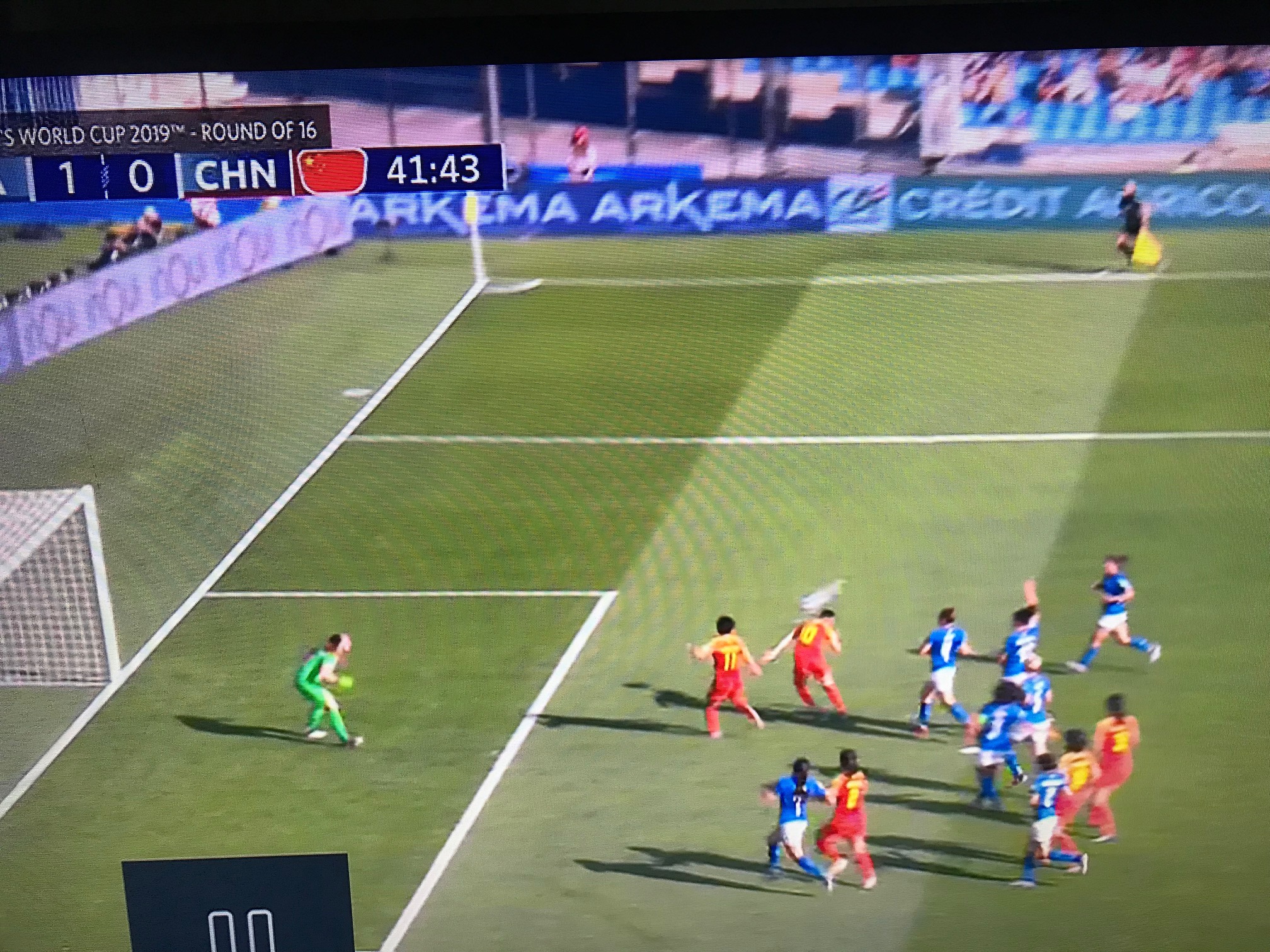
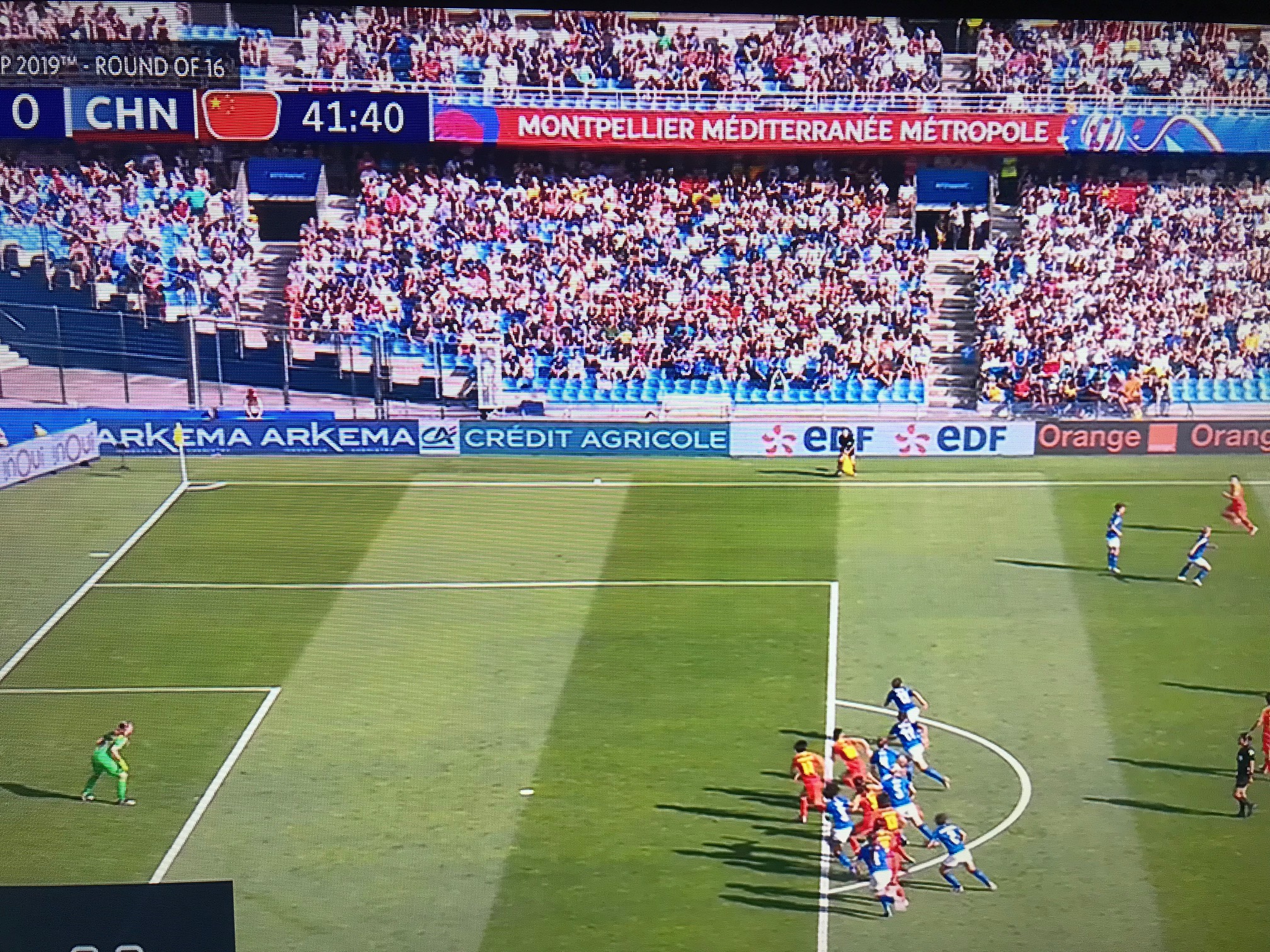
These are the three snapshots which informed the offside decisions, by Brazilian AR Tatiane Sacilotti dos Santos Camargo, on this attacking play. The play begins with a direct kick by China (Red) against Italy (Blue), in the 42nd minute.

FIRST SNAPSHOT: There is no offside offense “on the initial kick,” as the commentators suggested. This is the moment the ball is being kicked, offscreen to the right. The AR is even with the second-to-last defender, Italy #3 (Gama), who is establishing the offside line. In this case, because of Gama’s position, the imaginary offside line happens to coincide with an actual line on the field (marking the top of the penalty area). China #10 Li is clearly just behind the line.


(China #11 Wang is in a clear offside position here; she is ahead of the line established by Gama. However, she is not committing any offense. She is not initially going to interfere with play by touching the ball, nor is she interfering with an opponent, by any distracting movement or impeding an opponent’s view. Being in an offside position is not, in itself, an offense.)


SECOND SNAPSHOT: This is the moment China #10 heads the ball. She cannot be penalized for offside. She was not in an offside position when the ball was last touched by a teammate (the moment of the kick); she has legally run forward to play it.


However, note that in this snapshot, China #11 is still in an offside position. She is ahead of both the offside line, as established by the second-to-last defender (no longer Italy #3 Gama but now #7 Guagni), as well as the ball.

If China #11 plays the ball now — unless an opponent first deliberately plays it, or a teammate touches it (either of which would result in a new “snapshot”) — she will be penalized for offside. And…


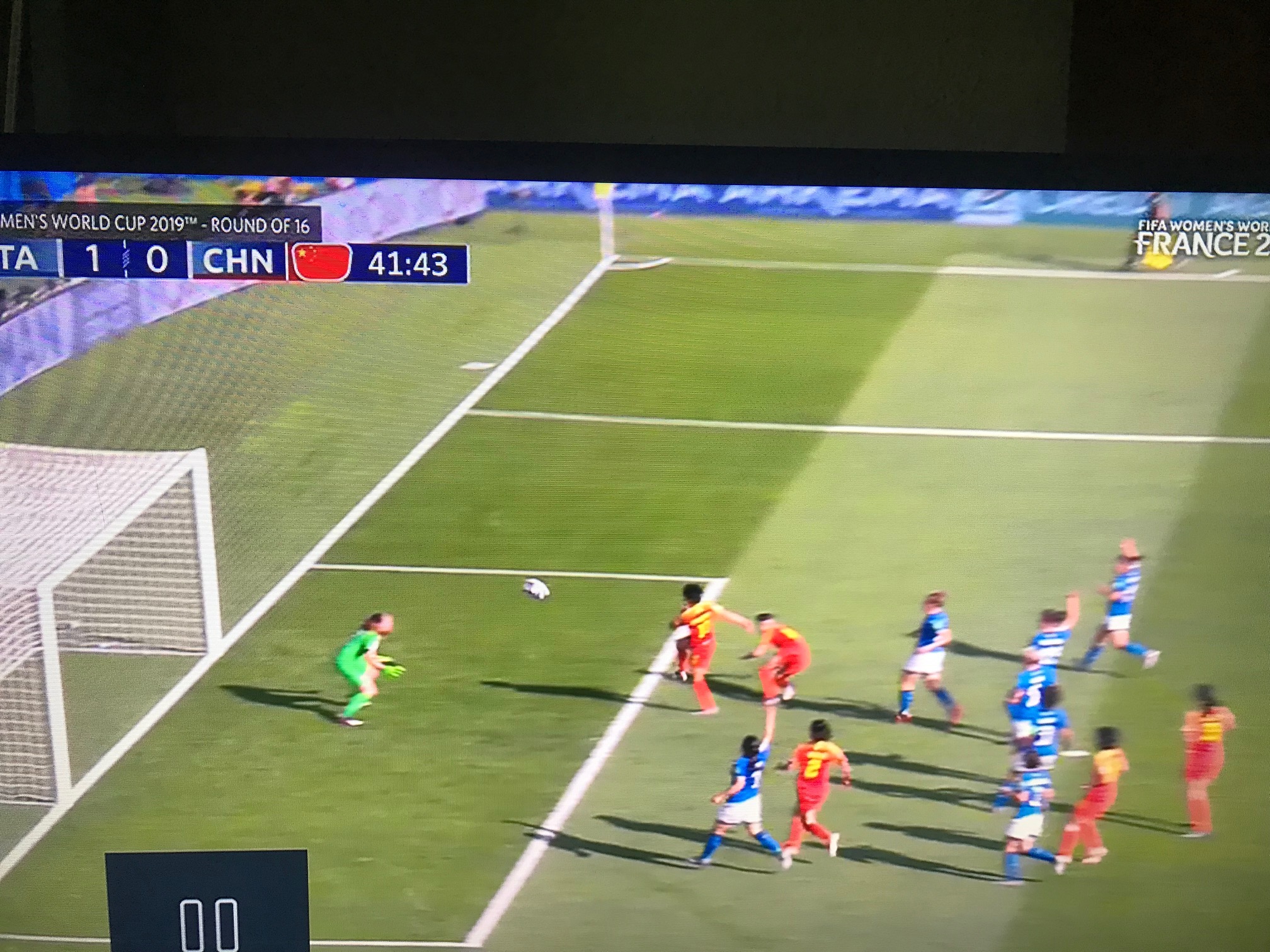
THIRD SNAPSHOT: Now China #11 plays the ball with her foot, redirecting it toward the goal, after it has been headed by #10. (The photo here is an instant after the kick by China #11.)


The ball then strikes the post and bounces back onto the field. AR Sacilotti dos Santos Camargo raises the flag, and China #11 Wang is penalized for offside. Wang has “interfered with play,” by playing a ball that was last touched by a teammate while she (Wang) was in an offside position.

For reference, the relevant portions of Law 11 are the descriptions of “Offside Position” and “Offside Offense.”

Hamilton Soundtrack with Lyrics

by Bryan Arthur Williams

Here is a lyrics video, created by YouTuber byuli, of the entire original Broadway cast recording of Hamilton: An American Musical (2015).

Until the release of an original cast DVD, listening to the cast recording, assisted by the lyrics, is the closest experience you can have to seeing the show on stage.

Unlike with most musicals, the entirety of Hamilton, apart from a short scene noted below, is included on the recording.

Below is a list of the songs/scenes, with a time code in the video for the start of each. In parentheses are the principal and named characters involved in each scene, with a slash between characters played by the same actor.

ACT I

0:00:00 1. Alexander Hamilton (Aaron Burr, John Laurens/Philip Hamilton, Marquis de Lafayette/Thomas Jefferson, Hercules Mulligan/James Madison, Alexander Hamilton, Eliza Schuyler [Hamilton], George Washington, Angelica Schuyler [Church], Peggy Schuyler [Van Rensselaer]/Maria Reynolds)

0:04:00 2. Aaron Burr, Sir (Hamilton, Burr)

0:05:25 3. My Shot (Laurens, Lafayette, Mulligan, Hamilton, Burr)

0:12:09 4. The Story of Tonight (Hamilton, Mulligan, Lafayette, Laurens)

0:13:45 5. The Schuyler Sisters (Burr, Angelica, Schuyler, Peggy)

0:16:51 6. Farmer Refuted (Samuel Seabury, Mulligan, Burr, Hamilton)

0:18:34 7. You’ll Be Back (King George)

0:22:11 8. Right Hand Man (Hamilton, Burr, Mulligan, Laurens, Lafayette, George Washington)

0:27:30 9. A Winter’s Ball (Burr, Hamilton)

0:28:21 10. Helpless (Eliza, Angelica, Hamilton)

0:32:50 11. Satisfied (Angelica, Eliza, Hamilton)

0:38:14 12. The Story of Tonight (Reprise) (Laurens, Mulligan, Lafayette, Hamilton, Burr)

0:40:15 13. Wait for It (Burr)

0:43:26 14. Stay Alive (Eliza, Angelica, Hamilton)

0:46:06 15. Ten Duel Commandments (Laurens, Hamilton, General Charles Lee, Burr)

0:47:55 16. Meet Me Inside (Hamilton, Burr, Laurens, Washington)

0:49:17 17. That Would Be Enough (Eliza, Hamilton)

0:52:13 18. Guns and Ships (Burr, Lafayette, Washington)

0:54:22 19. History Has Its Eyes on You (Washington)

0:56:00 20. Yorktown (The World Turned Upside Down) (Lafayette, Hamilton, Laurens, Mulligan)

1:00:00 21. What Comes Next? (King George)

1:01:39 22. Dear Theodosia (Burr, Hamilton)

<In the musical, there is a short scene here, called Tomorrow There’ll Be More of Us (Laurens, Eliza, and Hamilton) in which Eliza reads to Alexander a letter from John Laurens’s father informing them of his son’s death. Laurens appears onstage, in memory. It is the only scene not included on the soundtrack.>

1:04:40 23. Non-Stop (Burr, Hamilton, Angelica, Eliza, Washington)

ACT II

1:11:06 24. What’d I Miss (Burr, Jefferson, Washington)

1:15:01 25. Cabinet Battle #1 (Washington, Jefferson, Madison, Hamilton)

1:18:37 26. Take a Break (Eliza, Philip, Hamilton, Angelica)

1:23:23 27. Say No to This (Burr, Hamilton, Maria Reynolds, James Reynolds)

1:27:25 28. The Room Where It Happens (Burr, Hamilton, Madison, Jefferson)

1:32:41 29. Schuyler Defeated (Philip, Eliza, Hamilton, Burr)

1:33:46 30. Cabinet Battle #2 (Washington, Madison, Jefferson, Hamilton)

1:36:08 31. Washington on Your Side (Burr, Jefferson, Madison)

1:39:09 32. One Last Time (Hamilton, Washington)

1:44:04 33. I Know Him (King George)

1:45:42 34. The Adams Administration (Burr, Jefferson, Hamilton)

1:46:39 35. We Know (Hamilton, Jefferson, Madison, Burr)

1:49:00 36. Hurricane (Hamilton, Burr)

1:51:23 37. The Reynolds Pamphlet (Hamilton, Jefferson, Madison, Burr, James Reynolds, Angelica)

1:53:34 38. Burn (Eliza)

1:57:11 39. Blow Us All Away (Philip, Martha, Dolly, George Eacker, Hamilton)

2:00:10 40. Stay Alive (Reprise) (Doctor, Hamilton, Philip, Eliza)

2:02:00 41. It’s Quiet Uptown (Angelica, Hamilton, Eliza)

2:06:24 42. The Election of 1800 (Jefferson, Madison, Hamilton, Burr)

2:10:26 43. Your Obedient Servant (Burr, Hamilton)

2:12:55 44. Best of Wives and Best of Women (Eliza, Hamilton)

2:13:44 45. The World Was Wide Enough (Burr, Hamilton)

2:18:47 46. Who Lives, Who Dies, Who Tells Your Story (Washington, Burr, Jefferson, Madison, Angelica, Eliza)

The Tom Swifty Game

by Bryan Arthur Williams

My friend Andrea recently introduced me to the wordplay game “Tom Swifty.” The Wikipedia entry explains its origins, in a series of early 20th-century Tom Swift youth adventure novels, whose author avoids simply using the word “said” in attributing speech to characters.

The entry offers this basic idea:

A Tom Swifty (or Tom Swiftie) is a phrase in which a quoted sentence is linked by a pun to the manner in which it is attributed. Tom Swifties may be considered a type of wellerism. The standard syntax is for the quoted sentence to be first, followed by the description of the act of speaking. The hypothetical speaker is usually, by convention, called “Tom” (or “he” or “she”)... The archetypal example [is]: ‘We must hurry,’ said Tom Swiftly.

My father tells me that Tom Swifties were the rage among college and high school students in the mid-1960’s, when my parents first went to college (they finished in the early 1970’s). His father, who died five years a grandfather to me, was adept at the art, apparently.

My best Tom Swifties so far…

  • “I hate beer,” Tom whined.
  • “I wish someone would get this steamroller off me,” said Tom flatly.
  • “I lost my thumbs when I was young,” said Tom even-handedly.
  • “How much damn Tobasco did you put in this?” asked Tom heatedly.
  • “Guys, this is not becoming some ‘Lord of the Flies’ scenario,” insisted Tom pig-headedly.
  • “So far I can only play one simple song on the guitar,” answered Tom accordingly.
  • “Why is it so fucking hard to accept that I am gay?” asked Tom outraged.
  • “Sorry I am dumb,” apologized Tom wordlessly.
  • “I could beat you like a duck to water,” Tom metaphorically challenged.
  • “I would like my pie à la mode,” replied Tom frankly.
  • “If she is pregnant, it’s not my fault. My vasectomies are permanent,” snipped Dr. Tom.
  • “Come on, Jesus, I doubt it hurts that much,” said Tom crossly.
  • “Technically I am not a heartbreaker,” insisted Tom in a petty manner.
  • “I prefer my hot dogs with mustard and sometimes,” said Tom with relish, “with ketchup.”
  • “I like to follow the motion of the planets,” said Tom elliptically. “I also follow the Iditarod,” he added doggedly.
  • “I hung down my head,” cried Tom duly.
  • “Home is the sailor, home from the sea,” said Tom gravely.
Bryan Williams

Write a comment…


Art of the Musically Conscious Breakup: Exploring the Soundtrack to Someone Great

by Bryan Arthur Williams

Someone Great (Netflix, 2019) is a film about twenty-four hours in the lives of three women, on the cusp of thirty and best friends since college, who are facing major relationship and life changes. It marks the directorial debut for screenwriter Jennifer Kaytin Robinson.

This piece contains lots of spoilers. So if you haven’t seen the film yet, go watch it now!

Music, and the ways the three women relate to music, drive the film. The protagonist Jenny (played by Gina Rodriguez) is a music journalist; the plot revolves around the friends attending an annual music festival; and at points in the narrative, the characters are affected by hearing certain songs, whether sung live onstage by a favorite artist, a track in an old playlist, or on the radio in a bodega.

Music carries the main characters back to the past, connects them in their present, and propels them toward their future.

Robinson’s soundtrack selections include work by emerging and still relatively unknown artists, established Millennial anthems, and everything between. They also reflect the feminism of her screenplay, as well as the film’s representation of LGBT and people of color.

Two thirds of the 32 artists or performing acts featured in the soundtrack are women or all female bands, and an additional two (6%) are mixed-gender bands. At least two of the artists are LGBT. Over half the artists or acts (53%) are people of color or all-POC bands, while three more (9%) are integrated POC/white bands.

The film takes its title from the song “Someone Great” (2007) by LCD Soundsystem (lyrics here). The song is about grief after the death of someone you love, inspired by the death of lead singer James Murphy’s therapist. But as Robinson suggests, by the reference, the aftermath of a serious relationship can feel similar; grief is grief.

The band, influential for Robinson and many Millennials, refused to license, for use in the film, one of their best known songs, “All My Friends” (lyrics here). In the film, songs by LCD Soundsystem would have been a part of the characters’ memories of college. Robinson may have planned to use “All My Friends” for the end credits, or perhaps in place of Vampire Weekend’s “Mansard Roof” in Scenes 8 and 9.

***

SCENES WITH MUSIC

This is a guide to all the scenes of Someone Great which feature soundtrack music or references in the dialogue to songs or musical artists. You’re on your own for all the visual “easter egg” references to artists or lyrics, though!

Some of the songs in the film are objective sound, meaning they are heard by the characters within the narrative of the film (at a party, concert, played from a phone, etc.) Where not otherwise noted, the songs are subjective sound, either heard in a character’s head or as part of the narration of the film.

NB: Time code for the start of scenes is designated by the visual change to a new location or time, rather than sound. Music sometimes starts slightly earlier, in order to transition into the scene.

Scene 1 [0:00 in, 1:32:22 left]: “Int’l Players Anthem (I Choose You) by UGK, featuring Outkast (2014); lyrics here. As we come to learn, this scene is the first of many flashbacks in the film – this one to 2011, when the main characters are 23, after the (fictional) Neon Classic festival. The 2014 song is subjective sound, like much of the subjective sound of the film’s flashbacks, an anachronistic overlay of Jenny’s memory. In the scene, the characters reference performances by rapper A$AP Rocky, the band Postal Service, and its lead singer Ben Gibbard.

Scene 3 [3:09 in, 1:29:13 left]: “Supercut” by Lorde (2017); lyrics here. The song functions as a soundtrack to the social media “supercut of us” Jenny creates in her mind, retracing the arc of her nine-year relationship with Nate.

Scene 5 [5:26 in, 1:26:56 left]: “Motion Sickness” by Phoebe Bridgers (2017); lyrics here. The intro to this song plays over Erin and Leah’s conversation and kissing.

Scene 7 [8:52 in, 1:23:30 left]: The breakup “joint” Jenny has shared on her Instagram, a few seconds of which play on Erin’s phone as objective sound in this scene, is supposedly song from their senior year of college (2008-09), but actually seems to be a track called “Jenny said Instagram,” credited to the film’s music editor, Chad Birmingham. It may be released on the official soundtrack.

Scene 8 [11:20 in, 1:21:02 left]: “Truth Hurts” by Lizzo (2017); lyrics here —> “Mansard Roof” by Vampire Weekend (2008); lyrics here. “Truth Hurts” is objective sound in the scene; the song is playing on Jenny’s phone, as Erin arrives at her apartment, and they sing along and dance. “Mansard Roof” begins as objective sound in the present of Scene 8, and continues as objective sound in Scene 9 [12:16 in, 1:20:06 left], a flashback to 2008 winter break college party where Jenny and Nate meet, with the same song playing. Erin doesn’t recognize the song in either the the film’s present (2018) or in the 2008 flashback.

Scene 10 [14:53 elapsed, 1:17:29 remaining]: “Saturdays” by Twin Shadow, featuring HAIM (2018, lyrics here) continues as an (anachronistic) subjective soundtrack to this flashback scene of Jenny and Nate’s first sex, having begun playing during their dancing at the end of the previous scene, which cuts back and forth in transition.

Scene 11 [16:26 in, 1:15:56 left]: In hanging up the phone in this scene, Jenny makes a reference, as noted by Erin, to “Bye Bye Bye” (2000) by NSYNC, which would have been released when the characters were 12 years old.

Scene 12 [18:15 in, 1:14:07 left]: “Everybody Wants to Be Famous” by Superorganism (2018); lyrics here. In this scene, Jenny and Erin arrive at Blair’s office with a plan to spring her free for the day.

Scene 14 [21:19 in, 1:11:03 left]: “Scott Street” by Phoebe Bridgers (2017); lyrics here. Jenny visits Washington Square Park, which triggers a flashback to the day she and Nate established “their spot” on the edge of the fountain.

Scene 16 [25:31 in, 1:06:51 left]: “Fake Nice” by The Aces (2018); lyrics here. The friends run into Matt in a restaurant while eating lunch.

Scene 18 [27:47 in, 1:04:35 left] “The Perils” by Old Man Saxon (2016); lyrics here. The song is objective sound, playing in Mikey’s wristband-free “crib”. Jenny refers to the weed preferences of singer Beyoncé, and Mikey drops references to hip-hop producer Mike Dean‘s drug dealer and to Barbra Streisand, though to the latter for her directing rather than singing.

Scene 20 [30:57 in, 1:01:25 left]: Nate’s cousin Hannah lets slip to Jenny, Erin and Blair, when they meet on the street, that rapper Kanye West is the secret headliner for the Neon Classic show that night, albeit, as Jenny points out, “a problematic choice”.

Scene 21 [33:39 in, 58:43 left]: Reprise of the intro to “Motion Sickness” by Phoebe Bridgers (2017, lyrics here) as Blair walks into Matt’s workplace to get the wristbands for the Neon Classic show.

Scene 22 [34:06 in, 58:16 left]: “Deeper” by Saint Cava (2017), lyrics here. Blair and Matt have sex in Matt’s office.

Scene 23 [35:35 in, 56:47 left]: “Charcoal Baby” by Blood Orange (2018), lyrics here. Jenny and Erin buy ecstasy from and smoke with drug dealer Hype, in his apartment.

Scene 24 [37:42 in, 54:40 left]: Flashback to Nate saying “I love you” for the first time. The music used in this scene is likely a track called “Love Revolution,” credited to the film’s music editor Chad Birmingham. Scene 25 [0:40:20 in, 0:52:02 left] is when Jenny goes into the shower to tell Nate she loves him too. The song is likely to be another credited to Birmingham called “Bean’s Boogie“. These may be released with the official soundtrack.

Scene 28 [42:43 in, 49:39 left]: “Should I” by Phoebe Ryan (2017); lyrics here. Song continues into Scene 29 [42:47 in, 49:35 left]. Erin and Jenny go to the clothing store where Leah works.

Scene 30 [44:05 in, 48:17 left]: Jenny argues with Erin in the dressing room of Leah’s store and drops a reference to singer Liza Minelli.

Scene 31 [44:59 in, 47:23 left]: “Killer” by Phoebe Bridgers (2015); lyrics here. Flashback to Jenny and Nate’s fight on the street, the previous night.

Scene 32 [46:21 in, 46:01 left]: “Your Best American Girl” by Mitski (2016); lyrics here. Flashback to presumably the last time having sex Jenny and Nate have sex.

Scene 35 [51:52 in, 40:30 left]: “The Jump Off” by Lil’ Kim, featuring Mr. Cheeks (2003); lyrics here. The song is objective sound in the scene, played by Jenny on her phone and continues as objective sound in the dressing/dance montage [Scene 36: beginning 54:52 in, with 37:30 left], and when they are dressed for the show [Scene 37, beginning 55:38 in, with 36:44 left]. Jenny, Erin, and Blair would have been around 14 when “The Jump Off” was released. At the beginning of Scene 35, Erin says she has been having a weird dream about actor and singer-songwriter Michael Cera.

Scene 38 [55:52 in, 36:30 left]: “Dreaming of You” by Selena (1995); lyrics here. The song is objective sound playing in the bodega, when Jenny begins to sing along, joined by Erin and then Blair. The oldest song in the film, “Dreaming of You” was released shortly after the Tejano superstar’s death, when the characters would have been around six. The bodega manager shouts, “This isn’t your karaoke bar!” which, along with Jenny taking ecstasy outside the bodega, make a nice transition to Scene 40.

Scene 40 [58:44 in, 33:38 left]: “Karaoke” by Big Freedia, featuring Lizzo (2018); lyrics here. The track is objective sound in the film, part of a set by DJ Questlove, as the friends arrive at Sony Hall for the Neon Classic show.

Scene 41 [1:00:55 in, 31:27 left]: “Dope” by Jessie Reyez (expected 2019). This song is objective sound in the film, and the only song that, within the narrative, is performed by its artist. It continues as objective sound in Scene 42 [1:02:02 in, 30:20 left], Erin and Blair have left the stage area, during Reyes’s set, trying to prevent Jenny from looking for Nate. Blair, trying to make peace between Erin and Jenny, exclaims, “This is our song! We love this song!” (Within the fictional 2018 present of the film, maybe, but “Dope” remains unreleased in 2019; eventually the lyrics will be found here.)

Scene 45 [1:03:39 in, 28:43 left]: “Great One” by Jessie Reyez (2017); lyrics here. The song seems to begin as subjective sound, but in the transition to Scene 46 [1:06:13 in, 26:09 left], as Jenny leaves the bathroom, we realize it is objective sound; Jessie Reyez is still performing. Jenny searches the crowd for Nate and finds him watching the stage. Nate turns to see her, and after all the film’s flashbacks, they look at each other for 37 seconds in the present. Jenny mouths the words, “I can’t…I love you…I…no,” and she walks away.

Scene 48 [1:08:52 in, 23:30 left]: “Reasons Not to Die – Demo” by Ryn Weaver (2018); lyrics here. Jenny looks out of the car, hired by Matt’s office to drive them to the after-party. The song continues during Scene 49 [1:09:16 in, 23:06 left], Jenny’s flashbacks to three moments with Nate on the same street, at different points in their relationship.

Scene 52 [1:12:19 elapsed, 20:03 left]: “Missing U” by Robyn (2018); lyrics here. Jenny arrives at the after-party.

Scene 53 [1:13:53 in, 18:29 remaining]: The second-longest scene in the film (3:31), in which Erin and Blair visit Leah’s apartment to tell Leah she loves her, has no music — at least that we can hear. While Erin has the talk with Leah, she puts headphones on Blair, giving her a “silent disco” experience to accompany Blair’s ecstasy high. Blair’s exclamation (“I can feel the seasons changing!”) and the tempo of her dancing, in the background, suggest she might be listening to the 2014 hit “Seasons Change (Waiting On You)” by Future Islands. Just a guess, though.

Scene 54 [1:17:24 in, 14:58 left]: “Dynamite” by Sigrid (2017); lyrics here. Riding the subway Jenny writes about the end of the relationship in her journal, and we hear her words as a voice-over, along with the piano introduction to the song.

Scene 56 [1:19:44 in, 12:38 left]: “Do You Think About Me” by Captain Cuts & Zookëper, featuring Georgia Ku (2018); lyrics here. Erin and Blair arrive at the after-party, looking for Jenny. Blair finds Matt. The song continues into Scene 57 [1:19:53 in, 12:29 left] while Blair and Matt start to have sex in the bathroom.

Scene 59 [1:22:16 in, 10:06 left]: “Moon River” by Frank Ocean (2018); lyrics here. Jenny sits by the fountain in Washington Square Park and imagines a conversation with Nate.

Scene 60 [83:16 in, 9:06 left]: The final and longest scene of the film (4:30), in which the friends reunite in Washington Square Park and find resolution, has no music. Toward the end of the scene, Blair informs Jenny that Erin “basically Say Anything-ed” Leah [Scene 53] but “no boom box.” The reference is to the 1989 film Say Anything…, in which John Cusack serenades Diane Court outside her bedroom window, playing the Peter Gabriel song “In Your Eyes” (1986) on a boom box. The song dates from about two years before the birth of the characters, the film from around their first birthday.

Credits [1:27:46 in, 0:04:36 left]: “Call On Me (Ryan Riback Remix)” by Starley (2016), remixed by Ryan Riback; lyrics here.

Poems to Celebrate National Poetry Month, April 2019

by Bryan Arthur Williams

Monday, April 1: The Waste Land by T.S. Eliot (1922)

Tuesday, April 2: Spring by Edna St. Vincent Millay (1920)

Wednesday, April 3: Love After Love, by Derek Walcott (1976)

Thursday, April 4: Temporarily in Oxford by Anne Stevenson (1977)

April 4 bonus poem, for the anniversary: They Shot Him [spoken word], from The Black Voices: On the Streets in Watts by The Watts Prophets (1970)

Friday, April 5: Halley’s Comet by Norman Nicholson (1981)

Saturday, April 6: accidentally missed this day.

Sunday, April 7: Sand-Quarry, from Scenes with Moving Figures by Muriel Rukeyser (1935) NB: poem concludes on second page of Scenes with Moving Figures.

Monday, April 8, Poem 1: Paul Laurence Dunbar by Robert Hayden (1978)

April 8, Poem 2: Little Brown Baby by Paul Laurence Dunbar (1899)

Tuesday, April 9: Last Words by Sylvia Plath (1961)

Wednesday April 10: Gretel in Darkness by Louise Glück (1975)

Thursday, April 11: After Long Silence by William Butler Yeats (1932)

Friday, April 12: Who Said It Was Simple by Audre Lorde (1973)

Saturday, April 13: I’uni Kwi Athi? Hiatho. by Roberta Hill (1984)

Sunday, April 14: Abraham Lincoln’s Last Day (April 14, 1865); an excerpt of John Brown’s Body by Stephen Vincent Benét (1928) NB: the link is to a PDF of the full poem; the excerpt runs from “The gaunt man, Abraham Lincoln, woke one morning…” (p 370) through “…The black formless vessel carried him away.” (p 371)

Monday, April 15: Patriots’ Day by Richard Wilbur (1986)

Tuesday, April 16: In the Distant Past by Carrie Fountain (2014)

Wednesday, April 17: The Words Under the Words by Naomi Shihab Nye (1995)

Thursday, April 18: Crazy Horse Returns to South Dakota by Harley Elliott (1974)

Friday, April 19: Persimmons by Li-Young Lee (1986)

Saturday, April 20: Woman to Man by Ai (1973)

Sunday, April 21: Two Mexicanos Lynched in Santa Cruz, California, May 3, 1877 by Martín Espada (c. 1990)

Sunday, April 21 bonus poem: Easter Day, 1943 by A.L. Rowse (1943)

[NB: I am unable to locate either April 21 poem online, but both appear in A Year in Poetry, edited by Thomas E. Foster and Elizabeth C. Guthrie (1995)]

Monday, April 22: Elegy by Aracelis Girmay (2011)

Tuesday, April 23: The Truly Great by Stephen Spender (1933)

Wednesday, April 24: Afro-Latina [spoken word] by Elizabeth Acevedo (2015)

Wednesday, April 24 bonus poem: The End and the Beginning by Wisława Szymborska, translated by Joanna Trzeciak (2001)

Thursday, April 25: Genesis: The Resilient Colors by Roberto Tejada (2006)

Friday, April 26: [H B56: “Sweet Sue, /There is /no first, or last] by Emily Dickinson (c. 1864)

Friday, April 26 bonus poem: A Baroque Sunburst by Amy Clampitt (1985)

Saturday, April 27: The Contract Says: We’d Like the Conversation to be Bilingual by Ada Limón (2018)

Sunday, April 28: The Testing-Tree by Stanley Kunitz (1968)

Monday, April 29: Cross-Country Skiing by Maxine Kumin (1994)

Monday, April 29 bonus poem: Wondrous by Sarah Freligh (2012) NB: scroll down to the third poem.

Tuesday, April 30: Infinity Ghazal Beginning with Lice and Never Ending with Lies by Tarfia Faizullah (2018)

Final bonus poem: April Thirty-First by Barbara L. Greenberg (1974) NB: published in Greenberg’s The Spoils of August (1974) and reprinted in A Year in Poetry, edited by Thomas E. Foster and Elizabeth C. Guthrie (1995)

Janet Jackson, Stevie Nicks, and Fixing the Sexist Rock and Roll Hall of Fame

by Bryan Arthur Williams

Tonight Janet Jackson and Stevie Nicks will be inducted into the Rock and Roll Hall of Fame. As long as a Rock Hall continues to exist – we’ll get to that later – Janet Jackson and Stevie Nicks belong in it. The question is why it has taken so long. Jackson has been eligible for induction since 2008, and Nicks, as a solo artist, since 2007.

JANET JACKSON

Janet Jackson is one of the superstars in the history of American popular music. Ten of her songs have reached No. 1 on the weekly Billboard Hot 100, and an additional 31 have charted.

Christine Capetola offers a retrospective of Jackson’s work and the challenges she has faced in getting the recognition she deserves. Courtney E. Smith discusses the feminist message in Jackson’s music and image, and its influence on teenage girls of Gen X.

Here is more about Jackson’s place in history, as a performer of hit songs, from my ongoing research into Billboard history…

A Year-End Hot 100 Song is one that isn’t just a flash in the pan, but stays high enough on the weekly Hot 100 charts for enough weeks to be among the most popular hundred songs of the entire calendar year. Janet Jackson’s songs have made the Year-End Hot 100 lists 28 times.

She is seventh in Billboard history, for year-end hits, ahead of her brother Michael (27), The Beatles (27), and Stevie Wonder (25), and behind only Madonna (36), Mariah Carey (33), Rihanna (33), Elvis Presley (31), Drake (30), and Elton John (29).

Four of Janet Jackson’s songs have reached No. 1 and then went on to make the Year-End Top 10: “All For You” (#3 of 2001), “That’s the Way Love Goes” (#4 of 1993), “Miss You Much” (#5 of 1989), and “Together Again” (#6 of 1998). Five more songs, which also reached weekly No. 1, finished in the Year-End Top 20: “Again”, “Escapade”, “Doesn’t Really Matter”, “If”, and “Love Will Never Do (Without You)”. “Black Cat” (#59 of 1990) was her only weekly No. 1 to finish outside the Year-End Top 20.

STEVIE NICKS

Amanda Petrusich covered Stevie Nicks’s life and the enduring popularity and meaning of her music beautifully for The New Yorker in 2016, when the singer and songwriter’s first solo album, Bella Donna, was rereleased to celebrate its 35th anniversary. Here is more about Nicks’s career as a solo hitmaker, from my Billboard research…

Fourteen of Stevie Nicks’s solo songs have charted on the weekly Billboard Hot 100, with four reaching the weekly Top 10. “Edge of Seventeenwhich is easily the fan favorite among her solo songs today, to judge by Spotify streams, even if Billboard’s critics have anointedThe Glitter Never Fadesnever quite cracked the Top 10, peaking at No. 11 on April 17, 1982.

Between 1978 and 1986, also among the hottest years for Fleetwood Mac, six of Nicks’s solo songs made the Year-End Hot 100:

Whenever I Call You ‘Friend’” (#83 of 1978, with Kenny Loggins), “Stop Draggin’ My Heart Around” (#59 of 1981, with Tom Petty), “Leather and Lace” (#36 of 1982, with Don Henley), “Edge of Seventeen” (#100 of 1982), “Stand Back” (#44 of 1983), and “Talk to Me” (#57 of 1986).

She recently described that prolific period in an interview with Rolling Stone:

“I never wanted a solo career — I always wanted to be just in a band. But I just had so many songs! Because when you’re in a band with three prolific writers, you get two or three songs per album — maybe four. But I was writing all the time, so they just went into my Gothic trunk of lost songs… So I did the Gemini thing where you’re two different people — let’s give Stevie her solo career, without breaking up one of the world’s biggest bands. I was on a mission. Every time a Fleetwood Mac tour ended, I hit the ground running. I would already have songs ready for my next record. I’d take a week off, then I’d be in the studio. Everybody else would go on vacation.”

Stevie Nicks, February 28, 2019

As a solo artist, Nicks is in roughly the top 6% of performers in Billboard history for year-end hits, with the same number as Al Green, Dion, The Shirelles, and ABBA. Adding her six year-end solo hits together with Fleetwood Mac’s ten puts her in the top 1% of performing artists in history.

SEXISM IN THE HALL

Stevie Nicks is already in the Rock and Roll Hall of Fame, of course. She was inducted in 1998, as a member of Fleetwood Mac. She is being inducted this year for her solo career, and she is the first woman to be inducted twice. Asked about her achievement, Nicks replied: “It’s 22 to zero. It’s 22 guys that have gone in twice to zero women — Eric Clapton is probably in there 22 times already!

(Nicks was only slightly exaggerating the facts. Twenty-one men have been inducted into the Hall twice — in a band and as a solo artist, or with two different bands — while Eric Clapton has been inducted three times: first as a member of The Yardbirds in 1992, the following year as a member of Cream, then in 2000 as a solo artist. Great guitarist, sure, and he gave us some memorable songs. But if we polled the nation, how many Americans would vote Clapton the most important rock musician of all time?)

So how did the Rock Hall do in 2019, from a gender perspective?

The other inductees this year are all bands: The Cure, Def Leppard, Radiohead, Roxy Music, and The Zombies. Five all-male bands. So the bottom line is that that thirty-five more men and two more women will be entering the Hall tonight.

The list of performing artists – solo artists or members of duos or groups – who have been honored by the Hall of Fame now stands at 58 women and 691 men, or under 8% women. 7.7%, to be precise.

How did this happen? In addition to the underlying misogyny of the music business and rock culture, there is the institutional sexism of the nomination and voting process, as discussed by Julianne Escobedo Shepherd and others. But here’s how it went down over time…

In its first five years, the Hall inducted eighty-six men, but only five women: Aretha Franklin; Florence Ballard, Diana Ross, and Mary Wilson of the Supremes; and Zola Taylor of The Platters.

Over the next decade, the situation improved slightly, with 29 more female performers inducted along with 189 more men (13% women). So after fifteen years, 11% of the total performers honored by the Rock Hall were women. Between 2000 and 2009, female inductees slipped back down to 5%, and now another decade has passed with women inducted at the same pitiful rate.

And that’s only the performers.

The Rock Hall also honors behind-the-scenes “Non-Performers” – i.e. producers, songwriters, etc. So far the inductees are 94% men. The three women inducted, who were all at one time parts of husband/wife writing teams, were inducted with their then or former husbands.

Then there are “Early Influences” on rock and roll. These are artists banned to eternal purgatory for having made music, in some cases quite popular music, in the “Pre-Rock” Era. The inductees thus far are 87% men.

For a decade there was a category called “Sidemen”. Not surprisingly, these were only men. Fifteen of them. That looked bad, so in 2010 the category was renamed “Award for Musical Excellence”. Since then, the award has gone to fifteen more men. But also one woman! In 2014, guitarist Patti Scialfa was inducted as a member of the E Street Band.

Then there is the “Lifetime Achievement” award. So far, seven men and no women. And finally, a new “Singles” award for influential songs whose performers have not been recognized elsewhere. The first six songs inducted were by all-male acts.

These other categories have been a means to honor an additional 157 men and 11 women, bringing the overall representation of women in the Hall down to 7.5%.

While the institution may try to pat itself on the back for inducting more than one woman in 2019, it has done so eight times before, and not for the past six years.

You may be asking, but hang on – how many hit songs have women made anyway? Maybe inductions of women are roughly proportional to their success?

I happen to be currently working toward a precise answer to those questions, which involves categorizing about 6,500 songs and about 4,000 artists. However, by my best current estimate, female artists (solo and all-female duos and groups) have released about 35% of the year-end Billboard Hot 100 hits in history. Mixed-gender acts have made an additional 6% or so.

Safe to say that the Rock and Roll Hall of Fame presents a severely distorted gender portrait of popular music, past and present. Sadly the Rock and Roll Hall of Fame remains an institution which manages not only to play back, but to amplify the institutional sexism of the music industry.

CAN THE PROBLEMS BE FIXED?

Maybe.

For starters, let’s completely rebrand the institution as The Pop Music Hall of Fame.

Some say that’s what the name already means, but others would exclude performers (especially women) who made music in genres not considered “Rock and Roll,” and would continue to marginalize artists of the “Pre-Rock” Era. A rebranding will put an end to that nonsense.

“Rock and Roll” and “Rock” are words that meant specific things to many people at certain times. But we no longer live in those times. And even back then, could anyone ever agree what they meant? Certainly no one can argue in 2019 that the list of inductees reflects any coherent or consistent definition of “Rock and Roll” music.

Yes, the Hall includes many bands or solo artists that most would agree played some genre or subgenre of “rock”, in their respective eras. Performers such as, roughly in chronological order: Elvis Presley, Chuck Berry, Buddy Holly, The Beatles, The Rolling Stones, The Who, The Jimi Hendrix Experience, Led Zeppelin, Queen, Aerosmith, Heart, Patti Smith, Van Halen, The Pretenders, Bruce Springsteen, The Cars, Joan Jett & The Blackhearts, U2, Bon Jovi, Metallica, Guns N’ Roses, Nirvana, and Pearl Jam.

And yet the Hall also includes performers that most Americans would agree did not rock, or seldom rocked. Artists like Madonna, Al Green, Hall & Oates, The Temptations, Steely Dan, Billy Joel, The Mamas & The Papas, and Peter Gabriel.

  • There are disco artists in the Hall, including The Bee Gees, ABBA, and Donna Summer.
  • Hip-hop is represented by Grandmaster Flash and The Furious Five, Run-DMC, Beastie Boys, Public Enemy, N.W.A, Tupac Shakur, and now some of Janet Jackson’s work.
  • There are folk singers and singer songwriters, including Simon & Garfunkel, Joan Baez, Joni Mitchell, and James Taylor.
  • Reggae is represented by Jimmy Cliff and Bob Marley.

Did any of these artists identify their own music as rock and roll? Seems more likely they, and their fans, defined it as distinctly different from rock.

But we can agree that all these artists made or still make music and that they were, or are still, popular. Or if not widely known in their time, influential to artists who later became much more popular making similar music.

(The full list of inductees to the Rock and Roll Hall of Fame is here.)

Next steps: the institution needs to apologize for its long history of sexism, fire a bunch of men, and fix its nomination process and voting procedures. Then for a few years at least, maybe a decade, we need to see only women, and many women, inducted into The Pop Hall.

I can already hear men whining, No men at all? For years? Well, the Rock Hall has inducted no women at all on eight separate occasions: 1986 (its first year), 1989, 1992, 2001, 2003, 2004, 2009, and 2016.

Here are some female solo artists who are all eligible for induction, as it has been 25 years or more since their first record. These are no-brainers, because they each have more than ten year-end Hot 100 hits:

Mariah Carey (33 year-end hits), Whitney Houston (22), Olivia Newton-John (15), Diana Ross (13 as a solo artist, yet so far only inducted as a member of The Supremes), Dionne Warwick (13), Cher (12 as a solo artist), Patti Page (12), Connie Francis (11), and Celine Dion (11).

For further consideration, here are 26 more women eligible for induction, who have had three or more year-end Billboard hits: Mary J. Blige, Toni Braxton, Anne Murray, Paula Abdul, Taylor Dayne, Sheena Easton, Amy Grant, Carly Simon, Cyndi Lauper, Doris Day, Tina Turner (as a solo artist – she is already inducted as part of Ike & Tina Turner), Kay Starr, Annie Lennox (including both her hits as a solo artist and as part of Eurythmics), Pat Benatar, Mary Ford, Lesley Gore, Belinda Carlisle (as a solo artist), Cathy Dennis, CeCe Peniston, Dinah Washington, Dolly Parton, Georgia Gibbs, Irene Cara, Jennifer Warnes, Kim Carnes, and Melissa Manchester.

Then there are all-female groups with three or more year-end hits, who are currently eligible: TLC, The Pointer Sisters, The Go-Go’s, En Vogue, Exposé, Xscape, Bananarama, and The Andrews Sisters, who might be remembered as the most successful female group of all time, if Billboard had started tracking hits a few years earlier.

We also need to consider eligible and overlooked mixed-gender groups and duos, such as Gloria Estefan and Miami Sound Machine, Eurythmics, Captain & Tennille, Lisa Lisa and Cult Jam, and Ace of Base. The Hall could induct the women from these acts now, and then the men someday. There is precedent: Mary Ford is still waiting to join Les Paul.

That’s a start. But then we need to talk about eligible female solo artists, duos, or all-female groups with two year-end hits (to join two-hit male inductees The Zombies, Pink Floyd, Peter Gabriel, Pearl Jam, and 15 more.) Kylie Minogue and Kim Wilde, for example.

And the female one year-end hit wonders (to join one-hit male inductees Little Richard, Neil Young, Van Morrison, and Nirvana and 27 more.) For example, Barbara Lynn, Amii Stewart, and Sinéad O’Connor.

Or influential female artists with no year-end hits (to join no-hit male acts Roxy Music, Radiohead, The Cure, Led Zeppelin, and 34 more.) Tori Amos and Ani DiFranco come to mind. I mean, if they want to celebrate a couple great artists and prolific songwriters who also transformed the music business.

The approach is not without risk, of course. Women could achieve fair recognition and representation, and Maureen Tucker might still dismiss the place as the “Hall of Lame.” Cool gonna cool.